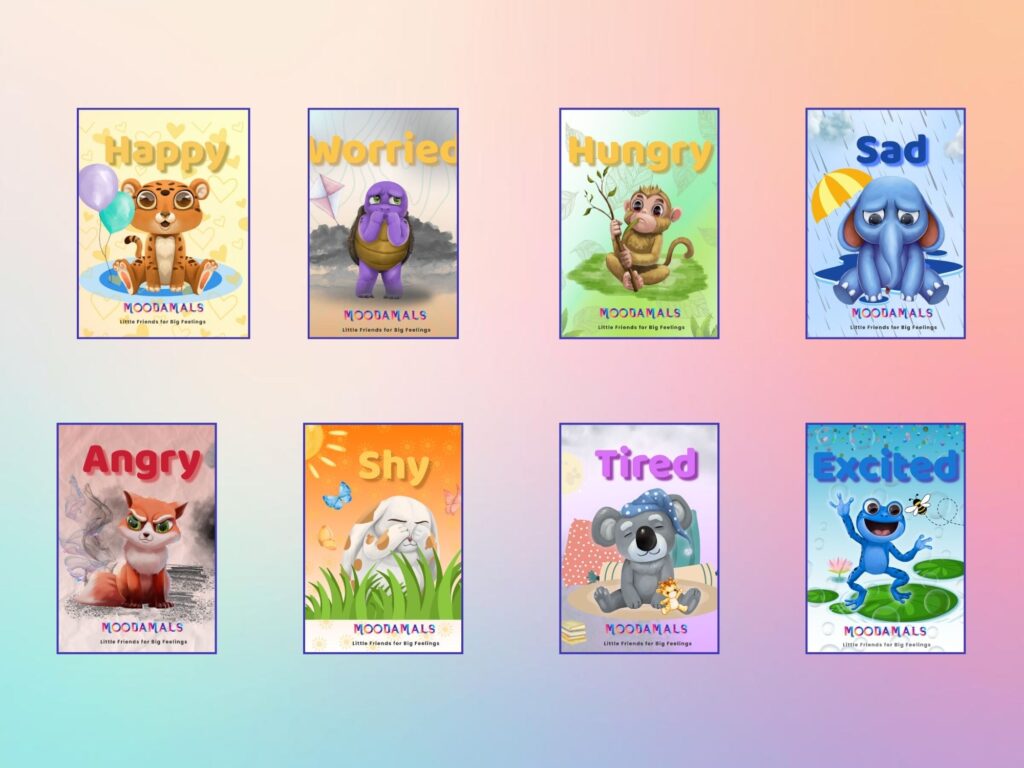
Helping kids with big feelings goes far beyond calming strategies or behavior charts. Once we recognize that children experience emotions deeply and differently, the next question becomes more important:
What does real emotional support look like in the exact moment big feelings show up?
In the first post, Helping Kids With Big Feelings: Little Friends for Big Feelings, I shared how Moodamals was created in response to what I kept seeing in classrooms and counseling spaces — kids struggling not because they were “misbehaving,” but because they lacked tools that matched their emotional experiences.
This post expands on that idea by focusing on what kids actually need in the moment when emotions feel overwhelming.
Big Feelings Don’t Follow Adult Timelines
One of the biggest challenges in supporting children’s emotions is that big feelings don’t appear on a schedule.
They don’t wait until:
- A calm transition
- A quiet classroom moment
- A counseling session
- A convenient time to talk
Instead, big emotions often show up:
- During learning
- In transitions
- At drop-off or pickup
- When expectations change suddenly
- When a child feels overwhelmed, misunderstood, or unsafe
In those moments, children aren’t trying to be difficult.
They’re trying to manage feelings that feel bigger than their current tools.
Why “Calm Down” Often Doesn’t Work
Adults are often taught to respond to emotional behavior with regulation strategies like:
- “Take a deep breath”
- “Use your words”
- “Count to ten”
- “Calm your body”
While these strategies can be helpful, they assume something important:
that the child is already regulated enough to use them.
For many children — especially younger kids or those with anxiety, sensory sensitivities, or strong emotional reactions — regulation strategies come after emotional understanding, not before.
When kids are told to calm down without feeling understood first, they may experience:
- Shame
- Frustration
- Disconnection
- Escalation instead of regulation
Emotional Support Starts With Recognition, Not Regulation
Before children can calm their bodies or problem-solve, they need emotional recognition.
That means acknowledging the feeling without trying to fix it right away.
Examples of emotional recognition include:
- “That looks really frustrating.”
- “Your body looks tense right now.”
- “This feels like a lot to handle.”
Recognition helps children feel less alone inside the emotion — and that sense of safety is what allows regulation to happen naturally.
Why Visual and Relational Emotional Tools Matter
Many kids don’t yet have the language to explain what they’re feeling — especially when emotions are intense.
That’s why visual and relational emotional tools are so powerful.
They allow children to:
- Point instead of explain
- Recognize emotions visually
- Connect with a character instead of searching for words
Moodamals were designed with this developmental reality in mind.
Each Moodamal represents a specific emotional experience, helping kids recognize and relate to feelings without judgment or pressure. Instead of being asked why they feel a certain way, kids can simply identify what they’re feeling.
This shift reduces stress and increases emotional safety.
Emotional Safety Comes Before Emotional Skills
Before children can learn coping strategies, self-regulation, or emotional skills, they need to feel emotionally safe.
Effective emotional support tools tend to be:
- Non-judgmental
- Developmentally appropriate
- Available in real moments, not just lessons
- Gentle rather than corrective
This is why emotional support doesn’t need to be loud, complex, or overwhelming.
Often, the most effective tools are simple, consistent, and familiar.
What This Means for Parents, Teachers, and Counselors
Supporting kids with big feelings isn’t about having the perfect response.
It’s about:
- Slowing down before fixing
- Noticing before correcting
- Connecting before redirecting
Kids don’t need adults to make their feelings disappear.
They need adults who help them understand their feelings and move through them safely.
Where Moodamals Fit Into Emotional Support
Moodamals aren’t meant to replace conversations, coping strategies, or emotional instruction.
They’re designed to support the space before those things happen.
The space where:
- Emotions are intense
- Words are hard to find
- Kids need reassurance more than solutions
Moodamals act as emotional bridges — helping kids move from overwhelm to awareness, and from awareness to growth.
Looking Ahead
In future posts, I’ll be sharing:
- How emotional tools support classrooms, homes, and counseling spaces
- Ways to use emotion-based supports without overwhelming kids
- Why emotional specificity matters for regulation and connection
If you support children through big feelings — as a parent, teacher, counselor, or caregiver — you’re in the right place.
This work matters.