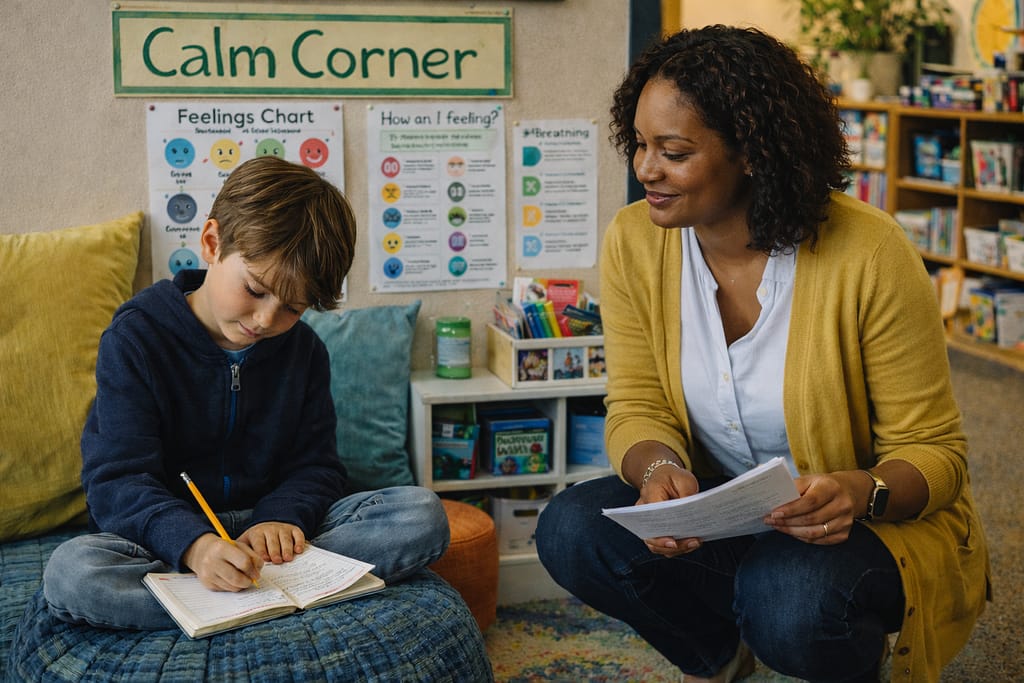
Student mental health in the classroom is often discussed in terms of counseling services or crisis support.
Those things matter.
But long before a student reaches that level of need, something quieter is happening inside the classroom every single day.
Structure is either strengthening a student’s sense of safety — or weakening it.
For many students, mental health support begins with something surprisingly simple:
Predictability.
And in many classrooms, predictability begins in the first 10–15 minutes of the school day.
Why Predictability Matters for Student Mental Health
For students, school is full of constant transitions:
• Home → classroom
• Free time → academic expectations
• Peer interaction → independent work
• One subject → another
Each transition requires emotional adjustment.
When classroom routines are inconsistent or constantly changing, some students experience increased stress — even if they don’t show it outwardly.
Predictability does something powerful:
- It lowers cognitive load
- Lower cognitive load supports emotional regulation
- Emotional regulation supports student mental health
Structure is not about control.
It is about safety.
The Nervous System and Classroom Routines
Student mental health is not just emotional — it is neurological.
When students know what to expect:
• Their nervous systems settle faster
• Anxiety decreases
• Defensive behaviors reduce
• Focus improves
When routines are unclear or reactive, students who already struggle with anxiety may feel constantly on edge.
That edge can show up in ways teachers see every day:
• Irritability
• Withdrawal
• Excessive talking
• Avoidance
• Emotional outbursts
Often these behaviors are signs of dysregulation — not defiance.
This is why classroom structure matters.
It helps regulate students before correction is ever needed.
Why “Busy Work” Doesn’t Support Student Mental Health
A worksheet on a desk does not automatically support student mental health.
Many classrooms rely on morning work that changes constantly, has no real purpose, or simply fills time.
That kind of routine may keep students quiet.
But it does not necessarily create stability or emotional awareness.
Student mental health improves when routines are:
• Consistent
• Familiar
• Purposeful
• Skill-building
Repetition builds emotional language.
Emotional language builds self-awareness.
Self-awareness strengthens regulation.
That progression is quiet — but incredibly powerful.
The Role of Daily Reflection
One of the simplest ways to support student mental health is through daily reflection routines.
When students regularly have the opportunity to:
• Name emotions
• Notice patterns in their behavior
• Reflect on choices
• Practice small moments of self-regulation
They begin building internal tools.
Those tools matter far beyond the classroom.
A predictable morning reflection routine becomes more than just a task.
It becomes a stabilizing anchor for the school day.
A Simple Shift for Teachers
Instead of asking:
“How can I fix student behavior?”
Try asking:
“What in my classroom structure supports student mental health?”
When routines are intentional and predictable, they reduce anxiety before behavior ever escalates.
This realization is what led me to focus more on long-term frameworks instead of constantly rotating disconnected activities.
A Free Way to Try This in Your Classroom
If you want to experiment with structured SEL morning reflection, I created a free preview teachers can try in their classroom.
It includes sample pages from my SEL reflection system designed for daily morning routines.
You can download it here:
👉 Free SEL Morning Work Preview for Elementary Classrooms
These pages give students a quick opportunity to check in emotionally, reflect, and start the day with calm structure.
A Full-Year Option for Consistent SEL Mornings
After using these routines in my own work with students, I created a full framework called:
180 Mornings About Me – SEL Morning Work for Grades 3–6
It provides 180 short daily prompts designed to build emotional awareness, reflection, and classroom connection throughout the year.
This is not a stand-alone mental health curriculum.
It is a structured system that quietly strengthens emotional skills over time.
👉 180 Mornings About Me – SEL Morning Work for Grades 3–6
If You Want to Go Deeper
If this topic resonates with you, you may also enjoy this article where I share practical ways to make morning work more meaningful:
👉Morning Meetings or Daily Structured Reflection? What Teachers Should Consider
It includes simple strategies you can start using tomorrow — even without a workbook.
Final Thought
Student mental health does not always depend on large interventions.
Often, it depends on steady routines.
And steady routines begin with structure.