Part 2 of 7: Seven Simple Classroom Systems for Teachers Carrying Too Much
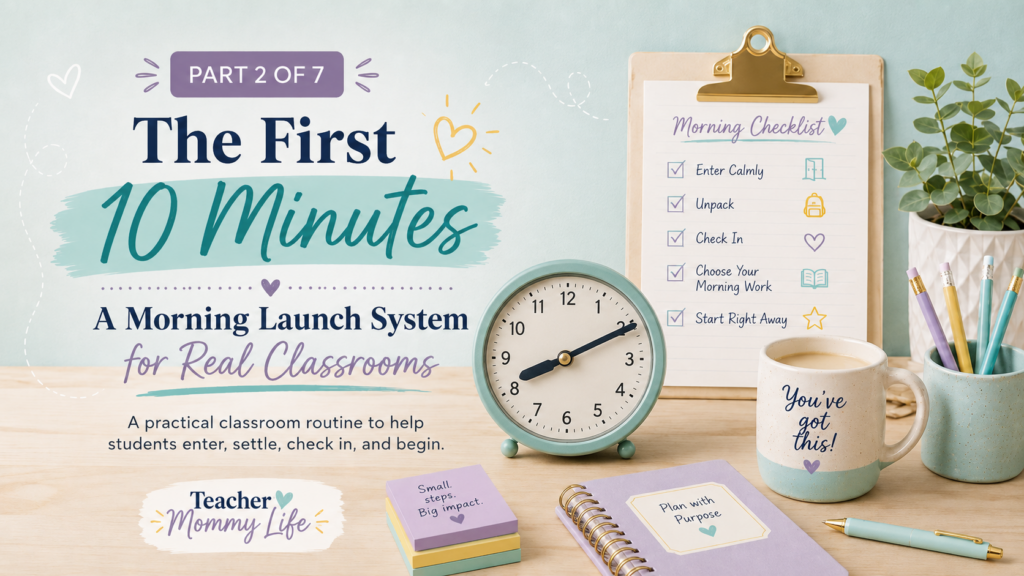
In this post, we are turning the first 10 minutes of the school day into a simple classroom system students can practice and teachers can actually maintain.
The first 10 minutes of the school day can tell you a lot.
Before the lesson starts, before the announcements are over, before everyone has sharpened a pencil or found their folder, you can usually feel the direction the morning is headed.
Some students walk in ready.
Some students walk in sleepy.
Some students walk in with a story they need to tell you right now.
Some students walk in carrying feelings from home, the bus, the hallway, breakfast, or something that happened before they ever got to your classroom door.
And you are supposed to greet them, take attendance, collect notes, manage lunch choices, answer questions, notice who seems off, redirect behavior, and somehow begin instruction.
That is a lot to carry before the day has even started.
If your first 10 minutes feel scattered, it does not mean you are doing something wrong.
It may just mean your morning needs a stronger launch system.
This post is part of a seven-post Teacher Mommy Life series: Seven Simple Classroom Systems for Teachers Carrying Too Much.
In Part 1, The Gentle Summer Reset for Teachers, we talked about stepping back, noticing what felt hard, and choosing one classroom system to simplify.
Today, we are taking that next step.
We are building a simple Morning Launch System for the first 10 minutes of the day.
Not a perfect routine.
Not a fancy routine.
A real classroom system that helps students enter, settle, check in, and begin.
The Problem: Teachers Become the Answer to Everything
When the morning routine is unclear, students naturally look to the teacher for every next step.
Morning questions can sound like:
- Where do I put this?
- What do I do now?
- Can I tell you something?
- I lost my pencil.
- I forgot my folder.
- Do we need our notebook?
- Can I go to the bathroom?
- What are we doing today?
One question is not the problem.
Twenty tiny questions before 8:05 can drain the teacher before instruction even begins.
The goal of a Morning Launch System is not to make children silent. Real classrooms are not silent little Pinterest boards.
The goal is to lower the number of decisions everyone has to make at the same time.
Students need to know what to do first.
Teachers need a few minutes to notice who needs support.
The whole room needs a predictable way to begin.
The Plan: Enter, Unpack, Check In, Begin
A Morning Launch System can be very simple.
I like to think of it in four parts:
1. Enter
2. Unpack
3. Check In
4. Begin
That is the whole system.
Students enter the room. They unpack and handle their basic responsibilities. They complete a quick check-in or morning reflection. Then they begin the first task of the day.
The beauty of this system is that it gives everyone a path.
Students are not waiting for you to carry the routine.
The routine carries the routine.
The 10-Minute Morning Launch System
Here is one way to structure the first 10 minutes.
You can adjust the timing based on your grade level, school schedule, breakfast procedures, announcements, and classroom needs.
0–2 Minutes: Enter and Unpack
Students enter the room, put away backpacks, turn in folders or notes, and make lunch choices if needed.
This part of the routine should be as predictable as possible.
If students ask the same questions every morning, that is a sign the routine may need to be more visible.
This could look like:
- Hang up backpack.
- Turn in folder.
- Make lunch choice.
- Get morning materials.
- Begin check-in.
For younger students, use pictures.
For older students, use a checklist on the board.
You do not need to make it cute before it works.
Start with clear.
2–4 Minutes: Start the Same First Task
After unpacking, students need a familiar first task.
This should be something they can begin without a long explanation from you.
For some classrooms, that may be a morning message.
For some, it may be independent reading.
For some, it may be a review page.
For my favorite version of this system, the first task includes a simple SEL check-in.
The content can change each day, but the structure should feel familiar.
“`Students should know:
This is where I start.
This is what I do first.
This is how I begin the day.
Predictability lowers the emotional load of the morning.
That matters for students.
It also matters for teachers.
“`4–7 Minutes: Complete a Quick SEL Check-In
This is where the morning routine becomes more than classroom management.
A quick SEL check-in gives students a small moment to notice how they are doing before the day starts moving quickly.
It can be one simple question:
- How am I feeling today?
- What do I need this morning?
- What is one choice I can make if I feel frustrated?
- What kind of day do I want to have?
- What is one thing that would help me start strong?
This does not need to become a full counseling lesson.
It does not need to take over the morning.
It is a small moment of self-awareness built into a routine students are already doing.
And it gives you information.
You may notice the student who keeps choosing tired.
You may notice the student who circles worried every Monday.
You may notice the child who never says, “I need help,” but writes it down.
You may notice patterns before behavior becomes the only signal.
That is one of the biggest benefits of a simple daily check-in.
7–9 Minutes: Teacher Scan and Quiet Support
While students are working, the teacher gets a small window to scan the room.
This is not the time to solve everything.
It is the time to notice.
- Who came in unusually quiet?
- Who seems frustrated already?
- Who is avoiding the task?
- Who looks like they need connection?
- Who is ready to begin?
A quiet check-in might sound like:
“`“I saw that you circled worried today. Do you want to talk now or after announcements?”
“Looks like you need a quiet start. Begin with the first question, and I’ll check back in a minute.”
“I’m glad you’re here. Start with number one, and I’ll come back around.”
That kind of support is simple, calm, and non-dramatic.
You are not turning the morning into a therapy session.
You are noticing early enough that behavior does not have to become the first message you receive.
“`9–10 Minutes: Transition Into Instruction
The final minute matters.
Students need to know how the Morning Launch System ends.
Otherwise, the routine can stretch, drift, or become another transition problem.
Use one consistent cue.
It might be:
- A timer.
- A chime.
- A call-and-response.
- A short phrase.
- A visual countdown.
- A soft song.
- A posted slide.
The cue should tell students:
The morning launch is ending.
We are moving into our first lesson.
You do not need a different cue every day.
You need one that students understand and can practice.
“`A Simple Teacher Script for Introducing the Routine
Students need to know why the routine exists.
You can introduce it with language like this:
“Every morning, we are going to start the same way. When you come in, you will unpack, turn in anything important, and begin your morning check-in. This helps us start the day calmly and helps me know how everyone is doing. You do not have to feel happy every morning. You just need a safe way to start and a way to let me know what you need.”
That explanation matters.
It tells students the routine is not just about compliance.
It is about support.
You can also say:
“Our morning launch helps your brain and body know, ‘I am here. I am safe. I know what to do next.’”
That is the heart of the system.
What This Looks Like in K–2
In K–2 classrooms, the Morning Launch System usually needs more visuals, modeling, and repetition.
A K–2 version might include:
- A picture routine near the door.
- A clear place for folders.
- A simple lunch choice system.
- A feelings check-in with faces or colors.
- A short morning work page.
- A calm transition cue.
Younger students often need to practice the routine many times.
They may need you to model it.
They may need pictures.
They may need reminders after weekends, breaks, or schedule changes.
That does not mean the system failed.
It means the system is still being learned.
For K–2 students, the check-in might be as simple as:
- I feel happy.
- I feel sad.
- I feel mad.
- I feel worried.
- I feel tired.
- I need help.
- I need a quiet start.
Young children often need emotional language before they can explain behavior.
A simple feelings routine gives them practice.
What This Looks Like in Grades 3–6
Older students still need a predictable start.
They may not need picture cards, but they do need clarity.
A grades 3–6 version might include:
- A written checklist on the board.
- A turn-in space for homework or notes.
- A short SEL reflection question.
- A daily emotional regulation prompt.
- A quiet work expectation.
- A consistent transition into the first subject.
Older students may not always say, “I am overwhelmed today.”
They may not say, “I had a hard morning.”
They may not say, “I need help.”
But they may write it.
They may circle it.
They may show you a pattern over time.
For grades 3–6, check-in prompts might sound like:
- What is one thing I need today?
- What is one choice I can make if I feel frustrated?
- What kind of support would help me this morning?
- What is one goal for the first part of my day?
- What emotion am I bringing into the room today?
The questions do not have to be complicated.
They just need to be consistent enough that students learn how to reflect.
What to Do When Students Still Interrupt You
Even with a strong system, students will still interrupt.
They will still ask questions.
They will still forget steps.
They will still walk to your desk while you are trying to take attendance.
That does not mean the routine is not working.
It means the routine needs a response plan.
Try creating a simple “before you ask me” reminder.
Before you ask the teacher, check:
- Did I unpack?
- Did I turn in my folder?
- Did I make my lunch choice?
- Did I start my morning check-in?
- Is this urgent?
You can also teach the difference between urgent and non-urgent morning needs.
Urgent
- I am hurt.
- I feel unsafe.
- I am sick.
- I have an important note from home.
Non-Urgent
- I cannot find my favorite pencil.
- I want to tell you something from yesterday.
- I have a question about something we are doing later.
This is not about ignoring students.
It is about protecting the first few minutes so you can actually notice the students who truly need help.
Optional Tool That Supports the System
Disclosure: As an Amazon Associate I earn from qualifying purchases. This means I may earn a small commission if you purchase through my links, at no extra cost to you. I only share tools that fit the classroom system described in this post.
You do not need a cart full of new classroom supplies to create a calmer morning.
The routine matters more than the stuff.
But one tool I do personally use and like is this visual timer.
I like it because it gives students a way to see time passing, which can be much calmer than repeated verbal reminders. I also appreciate that it is visually calming and has the option to turn the sound off.
That matters in a real classroom.
Some students need the visual support, but not the extra noise.
A visual timer can support the Morning Launch System by helping students see how much time they have to unpack, check in, and transition into the first lesson.
The timer does not create the routine.
The system does that.
The timer just makes the system easier to see.
How SEL Morning Work Fits Into the First 10 Minutes
Once the arrival routine is clear, the check-in part is often where teachers need something ready to go.
That is where SEL morning work can help.
The goal is not to add one more thing to your plate.
The goal is to give students a predictable way to begin the day while giving you a quick window into how they are doing.
A strong SEL morning work routine can help students practice:
- Naming feelings.
- Reflecting on choices.
- Thinking about coping strategies.
- Building self-awareness.
- Noticing what they need.
- Preparing for the day ahead.
This is why I created my 180 Days About Me SEL morning work resources.
They are designed to help teachers build a simple daily check-in routine without having to create prompts from scratch every morning.
Try the Free SEL Morning Work Samples
Want to try the check-in routine before building something from scratch?
Start with the free samples:
Ready for the Full-Year Routine?
If you want the full-year SEL morning work routine already built, you can find the complete resources here:
The visual timer helps support the structure.
The SEL morning work helps support the reflection.
Together, they can make the first 10 minutes feel less scattered and more intentional.
Final Thought
You do not need a perfect morning routine.
You need a repeatable one.
The first 10 minutes of the day will never be completely quiet, completely smooth, or completely predictable.
Real classrooms are full of real children.
But a Morning Launch System can help students know what to do first, give you a way to notice what they need, and create a calmer bridge into instruction.
Start with four steps:
Enter.
Unpack.
Check in.
Begin.
Make the routine visible.
Practice it slowly.
Use one consistent transition cue.
And remember: the goal is not to control every moment.
The goal is to give the morning enough structure that everyone can breathe a little easier.
Coming Next in the Series
Part 3 of 7: The Daily Check-In — A Simple SEL Routine That Helps You Notice Student Needs
Next, we will look more closely at how a daily feelings check-in can help students build self-awareness and help teachers notice patterns before they become bigger classroom challenges.