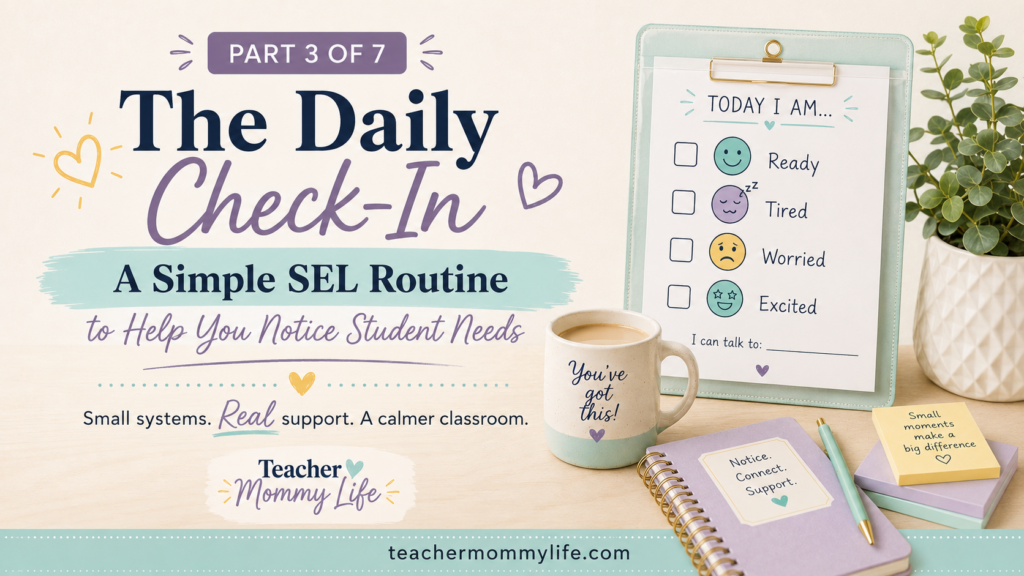
Part 3 of 7
The Daily Check-In: A Simple SEL Routine That Helps You Notice Student Needs
A gentle classroom systems series for teachers who want next year to feel calmer without adding one more giant thing to their plates.
By the time students walk into the classroom, they have already lived a whole morning.
One child may be tired. Another may have rushed out the door. Someone else may have had a hard goodbye. A few may be hungry, excited, or carrying something they do not have the words for yet.
Meanwhile, you are trying to take attendance, answer a question, check folders, greet students, manage supplies, start morning work, and remember whatever announcement you were supposed to make.
That is a lot.
Because of that, a daily check-in can be such a helpful classroom system.
It is not a huge SEL lesson. It is not a counseling session. It is also not one more thing that takes over your morning.
Instead, it is a simple, repeatable routine that helps students pause, name what is happening inside, and begin the day with a little more awareness.
In this series
This post is part of Seven Simple Classroom Systems for Teachers Carrying Too Much.
- Part 1: The Gentle Summer Reset
- Part 2: The First 10 Minutes
- Part 3: The Daily Check-In
Why Daily Check-Ins Matter
A daily check-in gives students a predictable place to put their feelings.
That may sound small, but it matters.
When students do not have a simple way to name what they are feeling, those feelings often come out sideways.
For example, those feelings may show up as:
- Avoidance
- Irritability
- Tears
- Talking over others
- Refusing work
- Shutting down
- Asking to leave the room
- Needing repeated reassurance
- Seeming off before the day even begins
Teachers often notice the behavior first because the behavior is what interrupts instruction.
In many cases, though, the behavior is not the beginning of the problem. It is the signal.
As a result, students need simple chances to notice the signal earlier.
Over time, a daily check-in can also help teachers notice patterns without having to guess all day.
A Daily Check-In Is Not a Full SEL Curriculum
This part matters.
A daily check-in does not replace counseling. It does not fix every behavior. Also, it does not mean teachers are responsible for solving every emotional need students bring into the classroom.
You are still one person. Your job still includes teaching, planning, grading, communicating, and managing a very full day.
On top of that, you still have standards, schedules, testing, meetings, emails, and 47 tiny things happening before 8:00 a.m.
That is why the routine should stay simple.
Instead of becoming another heavy responsibility, a daily check-in should be a classroom structure that helps students begin with awareness.
The Simple 3-Part Daily Check-In
1. How am I feeling?
This question helps students build emotional vocabulary. For younger students, it may look like choosing or coloring a feeling face. For older students, it may look like writing one word, circling a feeling, or choosing from a short list.
The goal is not to force a perfect answer.
In other words, students are simply learning to pause long enough to notice.
2. What do I need?
This question helps students connect feelings to needs.
For example, a tired student may need a quiet start. A worried student may need reassurance. Excitement may mean a child needs help slowing down. Frustration might mean a student needs space before starting work.
Because students are still learning these connections, the routine gives them practice in a low-pressure way.
3. What is one choice I can make next?
This keeps the check-in from becoming stuck in the feeling.
Then students begin to practice choosing a next step, such as:
- Take a breath
- Start with the first problem
- Ask for help
- Use a calm-down strategy
- Sit quietly for a minute
- Get a drink of water
- Try again
- Tell the teacher something important
A K–2 Daily Check-In Example
For younger students, keep it visual and simple.
A K–2 check-in might look like this:
How do I feel today?
Students color, circle, or point to a face.
Today I need:
- Help
- A quiet start
- A break
- A friend
- To try again
You do not need a long written response for little learners.
For this age group, the routine is the point.
A Grades 3–6 Daily Check-In Example
Older students can usually handle a little more reflection.
For grades 3–6, a check-in might ask:
What do you want your teacher to know about you today?
That one question can be powerful.
Some students will write something simple.
- I am tired.
- I am excited about my game.
- I forgot my homework.
- I am worried about the test.
- I had a hard morning.
At first, a few students may write nothing. That is okay.
Even then, the routine is still teaching them that there is a place to pause, reflect, and communicate.
What Teachers Can Look For
Over time, a daily check-in becomes more useful when you look for patterns.
However, you do not have to read every answer like a formal assessment. You are not grading feelings.
Instead, you are simply noticing things like:
- The same student marks worried every Monday
- A student often writes that they are tired
- A student repeatedly asks to work alone
- A student who usually writes a lot suddenly writes nothing
- Several students mention the same classroom stressor
- Students seem calmer when the routine is predictable
This kind of information helps you respond with more care and less guessing.
Teacher script you can use
“I saw your check-in. I’m glad you told me.”
“Let’s start with the first step together.”
“I noticed mornings have felt hard this week. We can make a plan.”
What If Students Share Something Big?
Every once in a while, students may write something concerning.
Of course, that does not mean the daily check-in caused the problem. It means the routine gave you a way to see something that may have already been there.
If a student shares something that suggests safety concerns, abuse, self-harm, harm to others, or a serious emotional need, follow your school’s procedures.
Then loop in the school counselor, administrator, social worker, nurse, or appropriate support staff according to your school policy.
Most importantly, the daily check-in is not asking teachers to handle everything alone. It is a way to notice earlier.
Make the Check-In Easy to Repeat
The biggest mistake is making the routine too big.
If it takes 25 minutes, it will not last. Also, if it creates a stack of papers you never have time to look at, it will start to feel like one more thing.
For example, one simple way to make daily check-ins easier is to slide a page into a reusable dry erase pocket sleeve. Students can use a dry erase marker, wipe it clean, and use the same page again later in the week.
Disclosure: As an Amazon Associate I earn from qualifying purchases.
Helpful classroom tool: reusable dry erase pocket sleeves
A Simple Daily Check-In Routine You Can Try
- First, students come in and begin the check-in page.
- Next, they answer one feelings question and one reflection question.
- Then you quickly scan responses while students settle into the morning.
- After that, you choose one or two students to quietly follow up with if needed.
- Finally, the class moves into the next part of the morning routine.
That is it.
The goal is not to turn every morning into a big discussion.
Instead, the goal is to create a calm, predictable place for students to check in before the day gets busy.
Try a Free SEL Morning Work Sample
If you want to try this routine without building it from scratch, I created free 10-day SEL morning work samples for both younger and older students.
Ready for the Full-Year Routine?
If you want a full-year system instead of creating new prompts every week, these resources give students 180 days of SEL morning work.
Related Posts in This Series
- Part 1 of 7: The Gentle Summer Reset
- Part 2 of 7: The First 10 Minutes
- Why Predictable Classroom Routines Support Student Mental Health
Final Thought
A daily check-in does not have to be complicated to be meaningful.
It can be one page, one question, and one quiet moment at the start of the day.
When students practice naming feelings, noticing needs, and choosing a next step, they begin building skills they can carry into the rest of the school day.
Meanwhile, teachers get a simple way to notice student needs earlier.
As a result, the morning can feel a little less reactive.
Not perfect. Not silent. Not magically easy.
Just more supported.
That is the kind of classroom system that helps students. And it helps teachers, too.
Coming Next in the Series
Part 4 of 7: The Calm-Down System: Teaching Regulation Before Students Are Upset