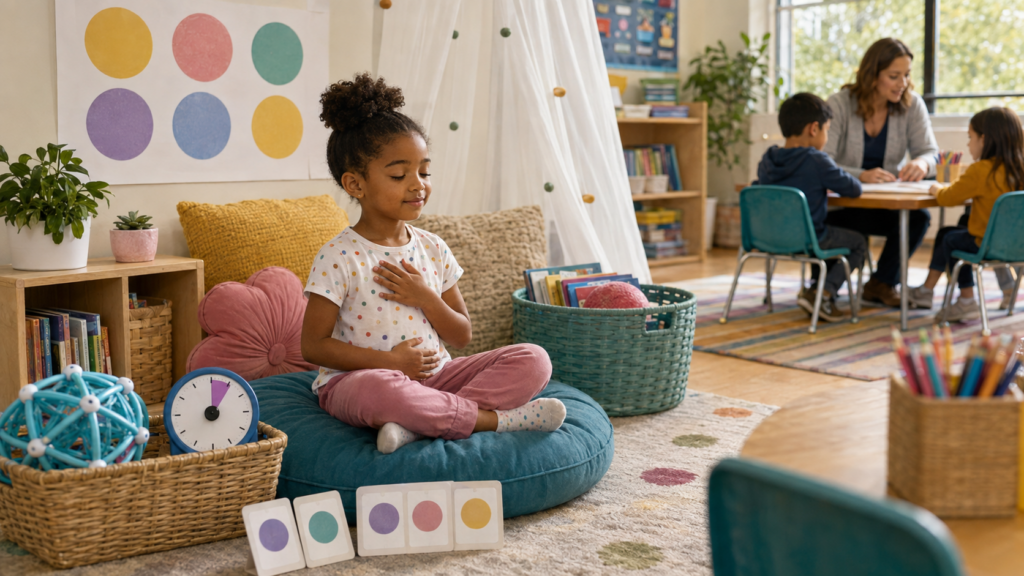
The Goal: Notice. Choose. Practice. Return.
A calm-down corner works best when students know exactly what to do there and how to take their next step back into learning.
Real classrooms. Real feelings. A routine students can remember.
Calm-down corners look wonderful in pictures.
There are soft pillows, perfectly organized baskets, peaceful posters, and possibly a plant that no child has ever knocked over.
Real classroom calm-down corners can look a little different.
A student may sit there for 20 minutes.
Another may visit because they would really prefer not to do math.
Someone will probably squeeze every fidget at the same time.
And eventually, a teacher begins to wonder whether the calm-down corner is actually helping anyone calm down.
I understand.
A calm-down corner for the classroom can be a powerful tool, but the space itself is not the system. Students still need to learn when to use it, what to do while they are there, and how to return to the classroom activity when they are ready.
In Part 4, The Calm-Down System, we talked about teaching emotional-regulation strategies before students are upset. Now we are giving those strategies a simple place and routine to live.
A Calm Corner Is Not Automatically a Calm System
You can fill a corner with pillows, posters, and every fidget known to elementary education. But if students have not learned how to use the space, the corner may quickly become one more thing for the teacher to manage.
The calm corner is the place. The routine is what makes it work.
What Is a Calm-Down Corner?
A calm-down corner is a small, predictable classroom space where students can practice regulating their emotions. It is not a punishment spot. It is not a place to send a child away because their feelings are inconvenient. It is also not a permanent escape from work.
The purpose is much simpler.
A student notices that their body or emotions are becoming overwhelmed. They move to a familiar space, choose a strategy they have already practiced, and then return when they are ready to take the next manageable step.
That process takes teaching. Just like we teach students how to line up, submit work, use classroom materials, or move through a center, we have to teach them how to use a calming space.
The honest part
Why Some Classroom Calm Corners Do Not Work
Usually, it is not because the teacher chose the wrong pillow or forgot to buy the perfect sensory tool.
What Gets Messy
- Introducing it only after someone is upset
- Offering too many tools at once
- Leaving the break open-ended
- Treating the space like a reward
What Works Better
- Practice while everyone is calm
- Begin with two or three choices
- Use a predictable time cue
- Always teach the return step
If any of these sound familiar, it does not mean the idea failed. It usually means the space needs a clearer routine.
Keep it memorable
The Simple Four-Part Calm-Corner Routine
I like keeping the routine short enough that students can remember it even when their brains and bodies are starting to feel overwhelmed.
Notice
Recognize a body signal, feeling, or behavior that says a break may help.
Choose
Select one familiar calming strategy instead of trying every tool.
Practice
Use the strategy for a short, predictable amount of time.
Return
Identify one small next step and return to the classroom activity.
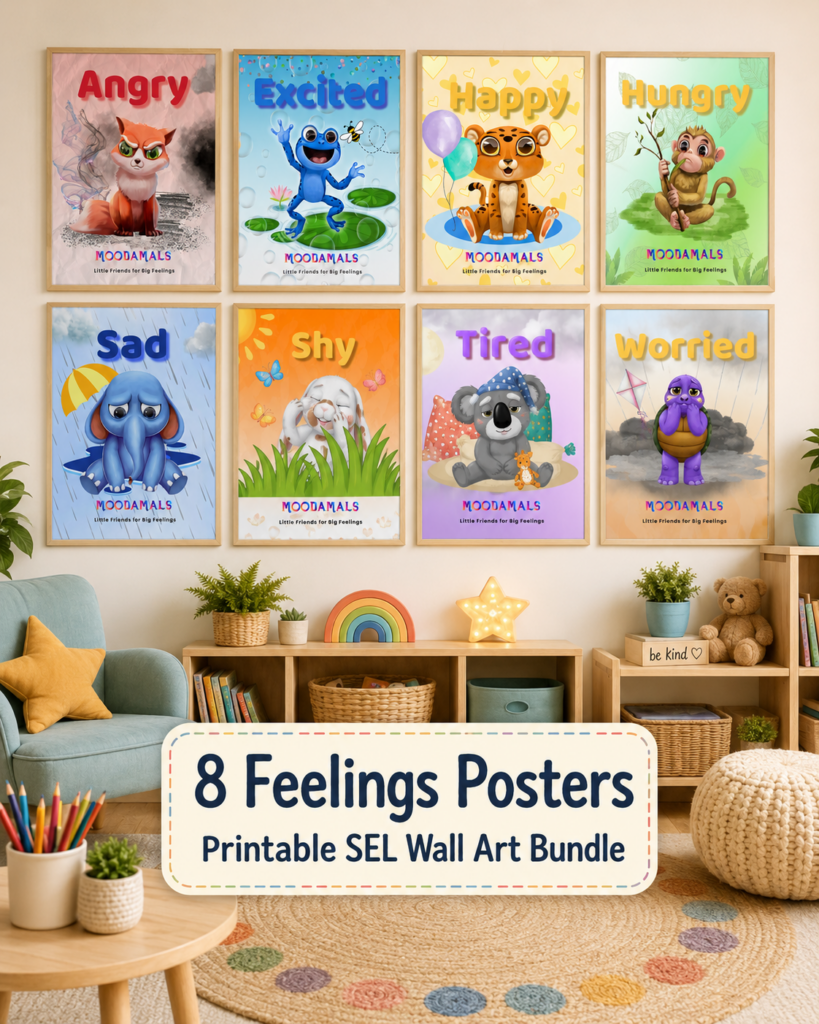
Start With Feelings Students Can Actually Name
Before a child can choose a calming strategy, they have to notice what is happening inside them. That sounds obvious. It is also where many calm-down corners get stuck.
A student may know that something feels wrong without having the words for worried, frustrated, tired, or overwhelmed. A clear feelings visual gives the student somewhere to begin.
That is why I created my Moodamals Feelings Posters. They are colorful enough to invite students in, but their real job is to help a child point, name the feeling, and move to the next step.
See the Moodamals Feelings Posters BundleWhat to Put in a Calm-Down Corner
You do not need seventeen fidgets, three kinds of putty, and a tiny waterfall that will absolutely get spilled.
A calm-down corner for the classroom works best when every item has a clear purpose and students have already practiced using it.
Two Calm-Corner Tools I Would Actually Consider
Neither of these tools creates self-regulation by itself. They simply make two parts of the routine more concrete: how long the break lasts and how to practice slower breathing.
A Visual Timer
“Take a short break” can feel vague. A visual timer lets students see time passing and makes the return step feel expected instead of sudden.
View the Visual Timer on Amazon Amazon affiliate linkAn Expandable Breathing Ball
Opening and closing a breathing ball gives students something concrete to follow while they practice a slow inhale and exhale.
View the Breathing Ball on Amazon Amazon affiliate linkHow to Introduce the Calm-Down Corner
Do not wait until a student is already upset to explain the space. Introduce it during a calm part of the day, model the complete routine, and let the whole class practice.
Teacher script
“Everyone has feelings that can become big sometimes. This space is here to help you notice what your body needs, choose one strategy, and get ready for your next step. It is not a punishment, and it is not a place to avoid learning. We are going to practice using it while everyone is calm so you know what to do when you really need it.”
Practice the Entire Routine
Model walking to the space, identifying a feeling, choosing one strategy, watching the time cue, putting materials back, and returning to a specific classroom task.
Then let students practice. Yes, the first practice may feel a little awkward. Most worthwhile classroom routines do.

Give Students Strategies They Already Know
A strategy card should not be a mystery a student has to solve while upset. Students are much more likely to use a calming strategy when they have already seen it, practiced it, and know what it is supposed to feel like.
That is the thinking behind my Moodamals Calm-Down Strategy Cards. Each card gives students one clear option without turning the calm corner into an overwhelming menu.
I would begin with only two or three cards. Add another choice after students can use the first ones appropriately. A smaller selection often leads to more independence.
See the Moodamals Calm-Down Strategy CardsWhat This Can Look Like at Different Grade Levels
The same four-part routine can work across elementary grades. Younger and older students simply need different language, visuals, and opportunities to reflect.
Keep It Visual and Concrete
- Use pictures for feelings and strategy choices.
- Model the routine frequently.
- Offer two or three choices at first.
- Use short, familiar language.
- Help the child name one next step.
Short daily feelings check-ins can build the vocabulary students need before they ever enter the calm corner.
Explore the K–2 SEL Morning WorkBuild Reflection and Independence
- Use a brief written or private check-in.
- Teach students to notice their own patterns.
- Use a predictable time expectation.
- Ask students to identify their return plan.
- Keep the routine private and respectful.
Consistent bell ringers can help older students connect their feelings, choices, and emotional-regulation strategies.
Explore the Grades 3–6 SEL Morning WorkWhat If a Student Uses the Calm Corner to Avoid Work?
This will happen.
If the calm corner is more comfortable than a difficult writing assignment, some students will naturally decide that they feel extremely called to regulate at that exact moment.
That does not mean you should remove the space. It means the routine needs a clear, predictable boundary.
- Acknowledge the feeling. The student does not have to prove they are upset before using a taught support.
- Keep the break predictable. Use the same time cue and expectations each time.
- Choose one practiced strategy. The space is for regulation, not open-ended play.
- Return to one manageable step. The original task does not disappear, but the first step can become smaller.
The break is real, and the expectation to return is also real. Both can be true.


The Return Step Is Part of the Calm Corner
A student can breathe more slowly, feel calmer, and still have absolutely no idea what to do next.
That is why “Return” belongs inside the calm-down routine. We are not expecting a child to move from overwhelmed to completely independent in one giant step. We are helping them identify one manageable way back into learning.
Part 6 of this series will go deeper into the return-to-learning routine because that transition deserves more than a quick sentence at the end of a calm break.
A Five-Minute Calm-Corner Reset
You do not have to redesign your entire classroom this weekend. Start with what will make the routine clearer.
- Remove any tools students do not understand or use appropriately.
- Choose two calming strategies to teach first.
- Post or say the four steps: Notice, Choose, Practice, Return.
- Model the entire routine while the class is calm.
- Choose one sentence you can use to guide students back to learning.
Calm-Down Corner Frequently Asked Questions
How long should a student stay in a calm-down corner?
There is no perfect number for every student, but the break should be short and predictable. The goal is enough time to practice a familiar strategy, followed by a clear return step. A visual timer can make the expectation easier to understand.
Is a calm-down corner a punishment?
No. It should be introduced as a regulation support, not a consequence. If students only encounter the space after getting in trouble, they are likely to experience it as punishment.
Does a classroom calm corner need to be large?
No. A chair, a small floor space, or a portable set of familiar strategy cards can work. The consistency of the routine matters more than the size of the area.
What if I do not have space for a permanent calm corner?
Create a portable version with a feelings visual, two or three practiced strategies, and a predictable time cue. Students can use it in a designated seat or another appropriate classroom location.
Should every student be allowed to use the calm corner?
Teach the routine to the entire class so the space is understood as a classroom support. Individual students may still need different limits, accommodations, or adult guidance based on their needs.
A Final Thought
You do not need a perfect calm-down corner for the classroom.
You need a simple space, a few familiar tools, and a routine students have practiced before they become overwhelmed.
Start small. Teach two strategies. Model the four steps. Practice the return.
The corner may never look like a perfectly staged classroom photograph. That is okay. It needs to work for the real children in front of you, in the middle of a real school day.
That is what turns a decorated corner into a system students can actually use.