
Calm Is Not the Finish Line
A student may be ready to leave the calm-down corner and still have no idea how to walk back into the lesson, repair what happened, or begin the work again.
Regulate. Reconnect. Take one small step.
There is a moment after a student calms down that nobody puts on the classroom poster.
The breathing is slower.
The tears have stopped.
The pencil may no longer be under the bookshelf.
Now what?
Sometimes we spend so much energy helping a student regulate that the next part catches us off guard. The student is calmer, but the unfinished math page is still waiting. A classmate may still feel hurt. The rest of the class has moved on, and everyone is suddenly looking at the teacher for the next move.
I understand that moment.
A return-to-learning routine gives teachers and students a predictable way forward. It does not pretend the difficult moment never happened. It also does not require a 20-minute conversation while 24 other students wait patiently. As we know, that is not usually how real classrooms work.
In Part 5, The Calm-Down Corner That Students Can Actually Use, we used four steps: Notice, Choose, Practice, and Return. This post focuses on that final step because “return” needs to mean more than simply telling a student to go sit down.
The goal is not to erase the hard moment. The goal is to help the student take the next manageable step.
What Is a Return-to-Learning Routine?
A return-to-learning routine is a short, repeatable process that helps a student reconnect with the classroom after becoming overwhelmed, taking a break, or using a calm-down space.
It answers the questions students may not be able to organize on their own:
- Where do I go now?
- What am I expected to do first?
- Do I have to talk about what happened right away?
- What if the work still feels too hard?
- What if someone else was involved?
The routine should be simple enough to use in the middle of an actual school day. It is not a counseling session, a public apology, or a lecture disguised as a check-in. In many cases, it can happen through one calm sentence and one clearly defined next step.
The part we sometimes miss
Why Returning to Learning Can Feel So Hard
From the outside, the next step may seem obvious. The student used a strategy, so now they should return and finish the activity.
However, the student may still be carrying embarrassment, confusion, worry about classmates watching, or frustration about the original task. Their body may be calmer while their brain is still trying to figure out how to reenter the room without making the moment bigger.
What the Adult May See
- The student looks calm now
- The class needs to keep moving
- The assignment still needs attention
- A consequence or repair may be needed
What the Student May Feel
- Everyone noticed what happened
- I do not know where the class is now
- The work still feels overwhelming
- I am not ready to explain it yet
Neither perspective is wrong. The teacher still has a classroom to lead, and the student still needs a way back in. A predictable routine helps those two needs meet without turning the return into another power struggle.
Keep the return predictable
The Four-Step Return-to-Learning Routine
The return should not feel like another test the student can fail.
Instead, use the same short sequence each time: Check. Connect. Choose. Begin. The words are simple on purpose. When a student has already used a lot of energy regulating, simple is useful.
Check
Quietly check whether the student can respond, make a choice, or follow one direction. Calm your own voice and keep the question brief.
Connect
Offer one neutral sentence that communicates, “You are still part of this classroom, and I am here to help you rejoin it.”
Choose
Give one manageable next step or two realistic choices. Avoid reopening every detail of the difficult moment before the student can reenter.
Begin
Help the student start for a few seconds. Then step back, check in again soon, and allow the classroom routine to carry them forward.
First, check readiness. Next, reconnect without making the student the center of attention. Then choose one small action. Finally, help them begin.
The entire routine may take less than a minute. Some students will need more support, but the sequence remains familiar.
- Can you take a step?
- You still belong here.
- Choose what comes first.
- Let us begin.
Words matter
Keep the Return Private, Brief, and Specific
A student who has just had a difficult moment probably does not need a public debrief beside the pencil sharpener. They need a way back into the classroom without feeling as though every person in the room is waiting for an explanation.
Whenever possible, move close enough to speak quietly. Use fewer words. Point to the exact page, seat, material, or action that comes next.
Try to Avoid
- “Are you finally ready?”
- “Tell me why you did that.”
- “You need to finish all of this.”
- “Everyone is waiting for you.”
Try This Instead
- “Show me where you are ready to begin.”
- “We can talk more after you settle back in.”
- “Start with this one part.”
- “I will help you take the first step.”
This does not mean ignoring behavior, unfinished work, or harm to another person. It means choosing the right order. Regulation and reentry usually need to happen before reflection, problem-solving, or repair can be productive.
Use the words until they become familiar
Teacher Scripts for Returning to Learning
You do not need a perfect sentence. In fact, a familiar sentence is often more helpful than a clever one. Choose a few that sound like you and use them consistently.
“You are ready to return. Bring your paper to the table, and we will begin the first question together.”
“The class is on number four. Start there, and I will check back with you in two minutes.”
“You do not have to explain everything yet. Point to the place where you are ready to begin.”
“The work is still yours, but you do not have to start it alone. Let us do the first part together.”
“Choose one more strategy. When the timer ends, I will come back and help you choose your first step.”
“Would you like to begin at your desk or at the back table? The first step is the same in either place.”
Support the beginning without removing the expectation. Small does not mean optional.
The best script is the one you can say calmly on a busy Tuesday while someone needs a Band-Aid, another student cannot find a library book, and your lesson is already three minutes behind.
Keep it short. Keep it kind. Make the next step clear.
What this looks like on a real Tuesday
Return-to-Learning Examples for Real Classroom Moments
The routine stays the same, but the next step changes depending on what happened. A student who missed five minutes of instruction needs something different from a student who had a conflict with a classmate.
Here are four moments teachers regularly manage and a practical way to respond.
When the Work Felt Too Hard
Do not hand back the entire page and repeat, “You need to finish.” Reduce the starting point, not necessarily the expectation.
Try: “Circle the problem you want to begin with. I will help you set it up.”
When a Classmate Was Involved
Return the student to a safe, neutral activity first. Then schedule a private repair conversation when both students can participate.
Try: “Begin at the back table. We will talk about what happened before recess.”
When Instruction Continued
Give the student a clear reentry point instead of expecting them to figure out everything they missed while regulating.
Try: “We are on the second example. Watch this one, and then you will try the next.”
When the Student Does Not Want to Return
Acknowledge that returning feels hard. Then hold the boundary with two appropriate choices and a predictable time cue.
Try: “You may begin at your desk or beside me. Choose before the timer ends.”
Notice that none of these responses begins with a long lecture. The student receives enough information to take the next step, while the teacher keeps the classroom moving.
What If the Calm-Down Break Becomes Work Avoidance?
Sometimes a student discovers that the calm corner is much more appealing than long division. That does not mean the student is being manipulative, and it does not mean the calming space has failed. It means the routine needs a clearer ending.
Keep the break predictable:
The original work does not have to disappear because a student needed a break. However, returning to a smaller first step can make the expectation feel possible.
For example, instead of saying, “Finish the page,” try:
- Complete the first problem with me.
- Write one sentence, and then I will check it.
- Listen to the next direction before beginning.
- Choose two questions to complete first.
- Rejoin the group from a nearby seat.
Small does not mean optional. It means we are creating an entry point the student can actually use.
Adjust the support, not the goal
What the Routine Can Look Like at Different Grade Levels
Kindergarten Through Grade 2
- Use fewer words and one-step directions.
- Offer picture choices or point to the next task.
- Walk back with the student when needed.
- Begin the first action together.
- Practice the routine during calm moments.
Grades 3 Through 6
- Keep the check-in private and respectful.
- Offer limited choices without talking down to the student.
- Let the student identify a manageable starting point.
- Use a short written plan when helpful.
- Return later for reflection or repair.
Older students do not necessarily need less support. Often, they need support that protects their dignity and does not make them feel singled out in front of their peers.
Reentry comes first. Reflection and repair come when the student has enough regulation to participate.
Accountability without the audience
Repairing Harm After a Student Returns
If another person was hurt, a material was damaged, or the class was disrupted, returning to learning does not erase the need for repair.
Still, timing matters. A forced apology delivered through clenched teeth is usually not meaningful repair. It may check a box, but it does not necessarily help the student understand the impact or rebuild trust.
When everyone is safe and regulated enough to participate, use a short repair process.
Name
Describe what happened using neutral, specific language. Separate the action from the student’s identity.
Repair
Choose one action that addresses the impact: check on someone, replace a material, clean a space, or try the interaction again.
Rejoin
Make the path back clear. The student should not remain socially exiled after completing an appropriate repair.
A simple script might sound like this:
“The marker was thrown, and it hit Maya’s paper. First, please check whether she is okay. Then replace the paper and return to your seat. We can practice a different choice together later.”
The correction is clear. The repair is connected to what happened. Most importantly, the student has a defined way to rejoin the classroom community.
Build Emotional-Regulation Skills Into the Daily Routine
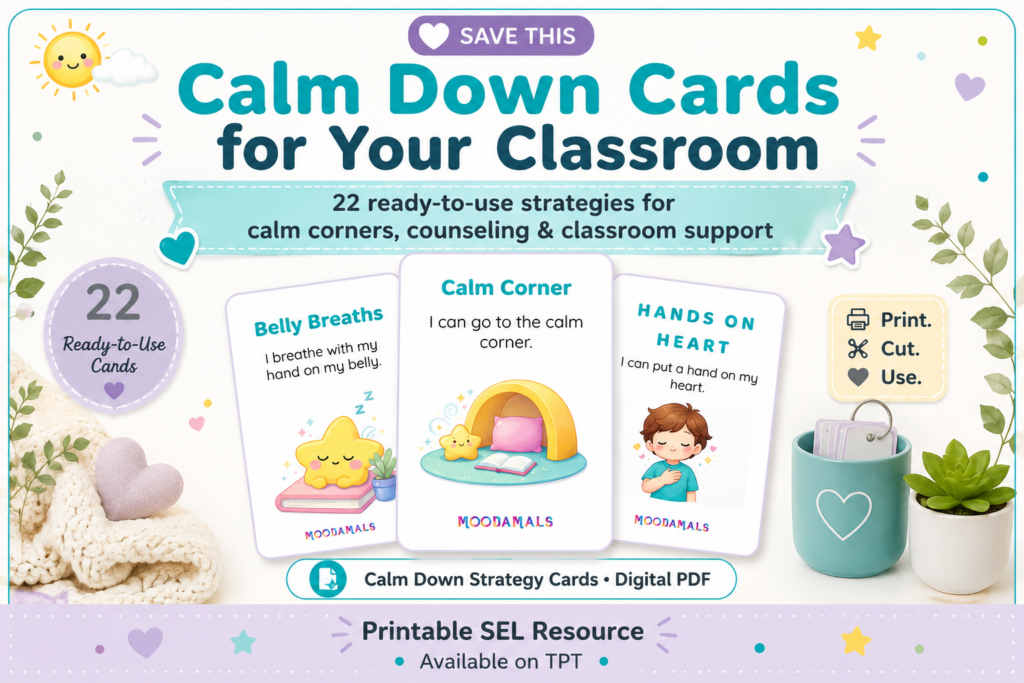
Students are more likely to name a feeling, choose a strategy, and return to learning when they have practiced those skills during ordinary classroom moments. My daily SEL morning-work resources give students that repeated practice in a format designed for their grade level. Choose the version that fits your students below.


A Five-Minute Return-Routine Reset
You do not need a new behavior system by Monday morning. Begin with one return routine you can repeat.
- Choose one sentence you will use when a student is ready to return.
- Identify one quiet place where a student can begin the first step.
- Decide how students will know a break is ending.
- Prepare one manageable reentry task.
- Teach the routine while the class is calm.
Helpful, not complicated
Two Tools That Can Make the Return More Predictable
You do not need a basket full of new supplies. However, two simple tools can make time and expectations easier for students to understand.
A Visual Timer
A visual timer can make the end of a calming break feel predictable. It also reduces the need for repeated verbal reminders while you continue teaching the rest of the class.
Amazon affiliate link See the Visual TimerReusable Dry-Erase Pockets
Place a return checklist, feelings choice, or short reflection page inside a dry-erase pocket. Students can mark one next step, wipe it clean, and use it again.
Amazon affiliate link See the Dry-Erase PocketsChoose tools that make the routine clearer. If a tool creates more explaining, monitoring, or arguing, it may not be the right tool for your classroom.
Return-to-Learning Routine Frequently Asked Questions
How soon should a student return after calming down?
There is no perfect number of minutes for every student. Look for enough regulation to respond to a brief direction or choose a manageable next step. A predictable timer can help, but readiness matters more than racing the clock.
Should the student complete the original assignment?
Usually, the learning expectation should remain, but the reentry point may need to be smaller. Begin with one problem, one sentence, or one supported action. Then build from that successful start.
Should a student apologize before returning to class?
Not necessarily. If someone was harmed, repair still matters. However, a private and regulated repair conversation is more meaningful than requiring an immediate public apology before the student can rejoin instruction.
What if the student begins escalating again?
Pause the return. Reduce language and demands, provide space, and follow the student’s individual plan or your school’s response procedures. Reentry can be attempted again when the student is able to participate safely.
Is this routine only for students who use a calm-down corner?
No. The same routine can help after a hallway break, a counselor check-in, a difficult transition, a conflict, or any moment when a student needs support reconnecting with classroom learning.
A Final Thought
A student does not need to return perfectly.
They need a path that feels clear enough to follow: one quiet connection, one manageable choice, and one small beginning.
The reflection can come later. The repair can happen when the student is ready to participate. For now, the return-to-learning routine communicates something important.
You had a hard moment, and you still belong here.