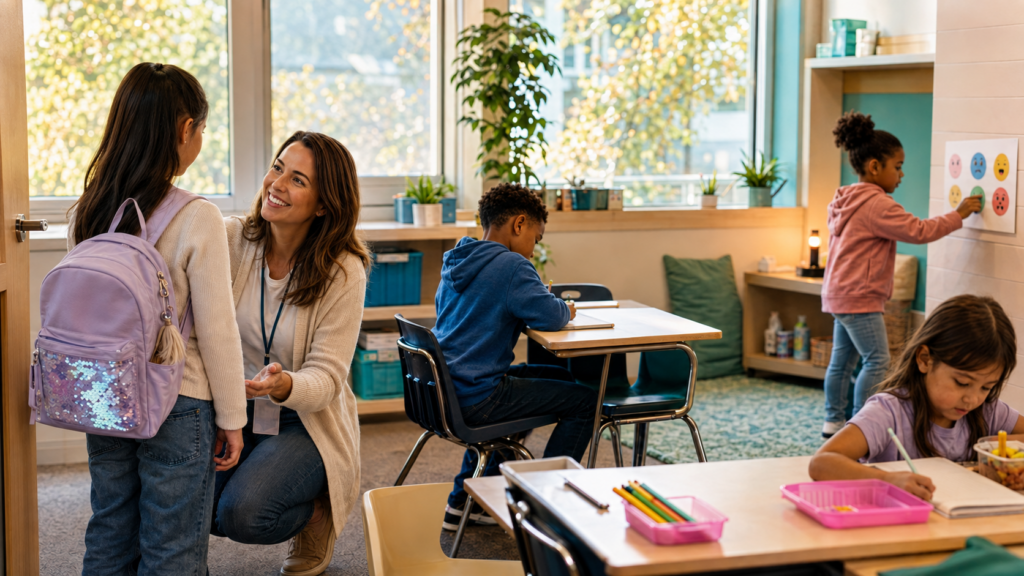
The Goal Is Not More SEL. It Is a System That Fits.
A classroom SEL system should help students know what to do while reducing the number of decisions teachers have to make in the middle of a busy day.
Notice. Practice. Regulate. Return. Repeat.
There is a point in every planning session when the tabs get out of control.
One tab has a beautiful morning routine.
Another has 47 feelings activities.
Somewhere in the middle is a calm-corner checklist, three breathing videos, and a resource you saved because the font was cute.
Suddenly, planning a calmer classroom has created its own small emergency.
I understand.
Teachers do not need another giant collection of disconnected ideas. They need a classroom SEL system that fits inside the school day they already have.
That is what this final part of the series is about. We are taking the routines from Parts 1 through 6 and connecting them so they support one another instead of competing for time.
In Part 6, The Return-to-Learning Routine, we focused on helping students reconnect after a difficult moment. Now we are stepping back to see how arrival, check-ins, skill practice, regulation, and returning to learning can work as one repeatable system.
The best classroom SEL system is not the one with the most pieces. It is the one students and teachers can actually use again tomorrow.
Connected, not complicated
What Is a Classroom SEL System?
A classroom SEL system is a small set of predictable routines that helps students notice what they are feeling, practice useful skills, regulate when needed, and reconnect with learning.
It is not one perfect curriculum. It is also not a stack of worksheets, a beautifully decorated calm corner, or a feelings chart that students only remember exists when an adult points to it.
The system works because each piece has a clear job and connects to what happens next.
A Collection of Resources
- Activities appear whenever there is time
- Students learn many strategies once
- Tools are introduced during difficult moments
- The teacher decides what to do each time
A Connected System
- Routines happen at predictable times
- A few useful strategies are practiced often
- Students learn the tools while calm
- The next step is already familiar
Resources can support the system, but the routine is what gives those resources a purpose.
The whole system at a glance
Five Parts of a Simple Classroom SEL System
You may already have several of these pieces. The goal is not to rebuild everything. First, notice what is already working. Then connect the missing steps.
Arrive
Use a predictable first-10-minutes routine so students know how to enter, settle, and begin without waiting for the teacher to direct every step.
Check In
Give students a brief way to notice and name how they are doing while helping the teacher spot patterns that may need attention.
Practice
Teach a few regulation and problem-solving strategies during ordinary, calm moments so students can use them when emotions become bigger.
Regulate
Provide a familiar routine, space, or portable set of tools that helps a student choose one practiced strategy and use it for a predictable time.
Return
Help the student reconnect with one clear, manageable step. Reflection and repair can follow when the student is regulated enough to participate.
These five parts do not require five separate programs. In a well-connected classroom SEL system, one routine often supports several needs at once.
This is also why a year-long resource is not useful simply because it contains 180 pages. It becomes useful when it anchors a routine students understand and teachers can repeat without rebuilding it every week.
Later in this article, I will show you exactly how my K–2 and Grades 3–6 SEL morning-work resources can become that daily anchor. First, let us see what the complete system looks like inside a real school day.
This can fit into the day you already have
What the SEL System Looks Like in a Real School Day
You do not need to stop instruction four times a day and announce that it is time for social-emotional learning.
You also do not need a perfectly quiet class sitting in a circle while soft music plays. The system still needs to work when someone cannot find a pencil, the announcements start early, and three students need you before you put down your coffee.
Here is what the five parts can look like inside an ordinary day.
Arrive and Check In
Students unpack, follow the same short arrival checklist, and complete one feelings or reflection prompt. You greet students, scan responses, and notice who may need a quiet check-in later.
Practice One Useful Skill
Review one familiar strategy: take three slow breaths, ask for help, use helpful self-talk, or name one manageable next step. This is practice, not a full lesson.
Use the Regulation Routine
The student uses a practiced tool, calm space, or short break. Because the choices are already familiar, you are not trying to teach a new strategy while the student’s brain is overwhelmed.
Return With One Small Step
Instead of asking, “Are you ready to do all of this now?” offer one clear place to begin. The student may answer the first question, join the group, repair a small part of the problem, or choose between two next steps.
A Five-Day SEL System Test Drive
Before you buy, print, laminate, or reorganize anything, try the system for five days. Use notebook paper, sticky notes, or whatever is nearby.
Notice
Ask: “How are you arriving today?” Students can answer with a feeling word, color, number, or quick drawing.
Name a Need
Ask: “What might help you learn today?” Offer simple choices such as quiet, movement, help, time, or encouragement.
Practice
Teach one strategy while everyone is calm. Practice it together for one minute. Keep the same strategy available all week.
Return
Practice the sentence: “I am ready to come back. My first step is ____.” Let students choose a realistic next step.
Reflect
Ask: “What helped you this week?” Notice what students used, what felt awkward, and what is worth repeating.
A simple teacher introduction: “This week, we are trying a short routine that can help us notice how we are doing and make a plan for learning. There are no perfect answers. We are practicing, just like we practice any other classroom routine.”
Please do not launch everything on Monday
How to Start Without Creating More Work
The temptation is to build everything at once. New chart. New corner. New routine. Possibly new baskets, because teachers are very vulnerable to a good basket.
Start with the part that would make the biggest difference in your classroom right now.
If Mornings Feel Chaotic
Begin with one arrival checklist and one daily check-in question. Practice those two pieces until students can begin with less adult direction.
If Big Feelings Take Over the Day
Begin with one calming strategy and one return phrase. Teach both while students are calm, then use the same language when a hard moment happens.
Your Free Four-Question Pocket Plan
Write these four questions on a sticky note, index card, or the first page of your planning notebook:
If you can answer these four questions, you already have the beginning of a classroom SEL system.
Try it for one week before adding more. Notice what students remember, where they still wait for adult direction, and which step makes your day easier.
You are not looking for perfection. You are looking for a routine worth repeating.


The year-long anchor
When the Five-Day Plan Works and You Want to Keep Going
This is the part where I tell you about the resources I created.
Not because every teacher needs another printable. Most teachers already have enough files saved in enough places to start their own small digital museum.
I created these resources because a daily check-in is only simple when the daily prompt is already prepared.
The routine may take five or ten minutes. Finding, writing, formatting, printing, and organizing a new prompt every day does not.
K–2 SEL Morning Work
A gentle, age-appropriate routine for young students who are still developing feelings language, drawing skills, and confidence as writers.
- 180 ready-to-use daily SEL pages
- Feelings check-ins and About Me reflections
- Opportunities to draw, write, notice, and share
- Short prompts designed for a 5-to-10-minute routine
- A consistent format young students can learn
Best fit: Primary classrooms that need a calm soft start, simple emotional vocabulary, and developmentally appropriate reflection.
See the K–2 Year-Long ResourceGrades 3–6 SEL Morning Work
A more independent routine for students who are ready to think more deeply about emotions, choices, relationships, and regulation.
- 180 ready-to-use SEL bell ringers
- Daily emotional-awareness and regulation prompts
- Reflection that supports student voice and perspective
- Independent writing that can lead into discussion
- A predictable start without busywork
Best fit: Upper-elementary classrooms that need meaningful morning work, stronger self-reflection, and consistent emotional-regulation practice.
See the Grades 3–6 Year-Long ResourceWhat Both Grade Bands Are Designed to Do
The pages are not meant to diagnose students or turn the classroom teacher into a counselor. They create a consistent place for students to pause, reflect, and practice language they can use throughout the rest of the SEL system.
Use the same resource in different ways
Three Ways to Fit the Routine Into Your Morning
The Five-Minute Start
Students complete the page independently while you greet students, take attendance, or handle the unexpected things that arrive with them.
The Ten-Minute Connection
Students complete the prompt, then share with a partner or discuss one optional question as a class.
The Weekly Look-Back
Use the pages independently during the week. On Friday, invite students to notice one pattern, helpful strategy, or success.
The real value is not one perfect page. It is what happens when students practice noticing, naming, reflecting, and choosing across an entire school year.
Make the Daily Check-In the Part You Do Not Have to Recreate
Begin with the free plan. When you are ready for a full year, choose the version that matches how your students read, write, and reflect.
Make it last past the first week
How to Keep the Classroom SEL System Working
New routines often look wonderful during the week we introduce them.
Then the copier jams. Someone changes the schedule. There is an assembly nobody remembered, and the carefully planned morning routine quietly disappears.
That does not mean the system failed. It means the system lives in a school.
When it gets messy, return to the smallest version that still helps.
Use the Same Language
Repeat a few familiar words: notice, choose, practice, return. Students use a routine more easily when the language stays predictable.
Reteach Before Replacing
If students stop using a tool well, practice it again while everyone is calm. A routine may need a reset, not a completely new system.
Notice Patterns, Not Perfect Pages
Look for repeated feelings, needs, and strategies. The goal is useful information, not flawless handwriting.
Protect What Helps You, Too
Keep the parts that reduce decisions and create connection. Simplify anything that requires more teacher energy than it gives back.
A Simple 30-Day Implementation Plan
Introduce the check-in and one regulation strategy. Model exactly what students should do.
Add the calm-space routine and the first step back to learning. Keep your language consistent.
Notice what students use independently. Reteach one weak step and remove anything that adds confusion.
Download a Free 10-Page SEL Morning-Work Sample
If the five-day system made your mornings feel more purposeful, try ten pages from the year-long resources before deciding whether the full routine fits your students.
Questions teachers may still have
Classroom SEL System FAQs
Does SEL morning work replace a counselor or SEL curriculum?
No. Daily reflection supports self-awareness and emotional language. It does not replace counseling, intervention, crisis support, or a required SEL program.
Do I need to read every response every day?
No. Decide on a manageable system. You might scan pages during morning work, review a small group each day, use a private “please check in with me” signal, or invite students to share selected responses.
What if a student does not want to share a feeling?
Do not force public disclosure. Students can choose a general word, draw, write privately, or pass during discussion. A check-in should create access to support, not pressure students to perform vulnerability.
What if the routine stops working?
Return to one step. Reteach the check-in, one strategy, or the return routine. Classroom systems need maintenance. You do not have to throw away the whole plan because one week became messy.
Choose the Version That Fits Your Students
You can start free. You can also save yourself the work of creating 180 days of prompts when you are ready for a year-long routine.
Seven Simple Classroom Systems for Teachers Carrying Too Much
- The Gentle Summer Reset
- The First 10 Minutes
- The Daily Check-In
- The Calm-Down System
- The Calm-Down Corner That Students Can Actually Use
- The Return-to-Learning Routine
- Putting the Classroom SEL System Together
You do not have to build everything tomorrow. Ask one meaningful question. Practice one useful strategy. Make the first step back clear. Then repeat what helps.